.Every home you have ever lived in, every office you have worked in, every building you walk past on your way to the train station, started the same way: a stack of timber and a set of plans. Someone had to turn that stack of timber into a frame that could hold a roof, carry a load, and stand for decades. That someone is a carpenter.
Carpentry is one of the oldest trades in the world, and it remains one of the most practical. This article looks at what the trade actually involves, what training in Australia covers. Where the industry is heading, including a growing number of women stepping into roles that were once almost entirely male.
What Carpentry Actually Involves
Carpentry covers the setting out, manufacturing, construction, assembly, installation and repair of structures built from timber and non-timber materials, across both residential and commercial construction.
In Australia, the nationally recognised trade qualification for this work is the CPC30220 Certificate III in Carpentry, a Certificate III level qualification delivered under the Australian Qualifications Framework. [1]
Occupational titles under this qualification include:
- Carpenter
- Carpenter and Joiner
- Commercial Carpenter
- Formwork Carpenter
- Residential Carpenter
Source [1]: City College Perth — CPC30220 Certificate III in Carpentry course page, citycollege.edu.au/course/CPC30220-certificate-iii-in-carpentry
The Skills Behind the Trade
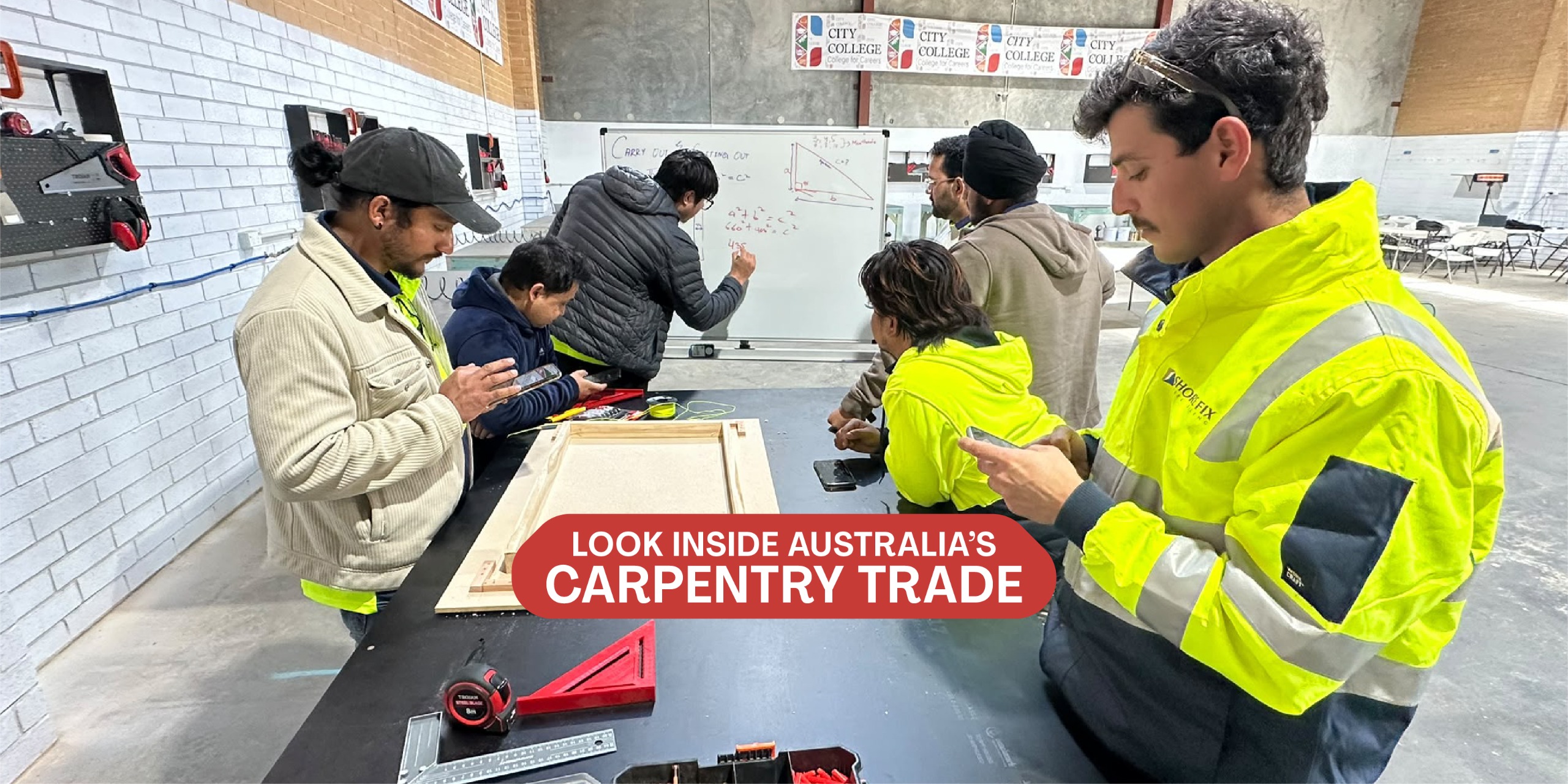
It is easy to look at a finished timber frame and assume the job is mostly hammering nails in straight lines. In practice, the trade sits at the intersection of physical skill, mathematics, and problem solving. Training in this trade covers:
- Reading and interpreting plans and construction drawings before any tool is picked up [2]
- Setting out, constructing and erecting wall frames, ceiling frames and roof trusses [2]
- Constructing pitched roofs and eaves, and progressing into advanced roof construction [2]
- Installing flooring systems, windows, doors and exterior cladding [2]
- Erecting and dismantling formwork for footings, slabs, stairs and ramps [2]
- Construction calculations to determine material requirements [2]
- Basic levelling procedures and working safely at heights [2]
- Work Health and Safety requirements specific to the construction industry [2]
Source [2]: City College Perth — CPC30220 Certificate III in Carpentry, Training Package Rules and Unit Listing, citycollege.edu.au/course/CPC30220-certificate-iii-in-carpentry
A carpenter working to trade standard needs to translate a two-dimensional plan into a precise three-dimensional structure, adapt on the spot. When a site condition does not match the drawing, and work safely at height on scaffolding and roof structures. That combination of technical knowledge and physical precision is what separates a qualified tradesperson from someone simply handy with tools.
Why the Trade Is in Demand Right Now
Trade apprenticeship completions across Australia reached more than 51,000 in the year to March 2025, up nine per cent on the previous year, and the highest number in a decade. [3]
That growth reflects a construction sector under sustained pressure to build. New homes, commercial developments, and infrastructure projects across Western Australia all require carpenters at multiple stages of a build, from framing through to finishing. Carpentry skills are used across a range of construction activities, including framing, structural work, fit-outs, and finishing.
Carpentry has featured among the priority construction trades identified for additional government support, with incentive payments introduced specifically for apprentices in carpentry. Alongside electricians and plumbers, reflecting government efforts to support training in key construction trades. [3]
Source [3]: Australian Government, Department of Employment and Workplace Relations — “More apprentices to build Australia’s future,” Ministers’ Media Centre, September 2025, ministers.dewr.gov.au/giles/more-apprentices-build-australias-future
Women in Carpentry: A Trade That Is Changing
Carpentry, like most construction trades, has historically been overwhelmingly male. That picture is shifting, and the data shows a genuine trend rather than a one-off spike.
Moreover, national data from the National Centre for Vocational Education Research shows almost 80 per cent more women training as apprentices in male-dominated trades, therefore reflecting a significant jump and real structural change in who is entering these industries. [4]
Source [4]: Australian Government, Department of Employment and Workplace Relations — “Nearly 80% increase in women learning a trade,” Ministers’ Media Centre, ministers.dewr.gov.au/giles/nearly-80-increase-women-learning-trade
Jobs and Skills Australia has recorded significant growth specifically in the number of women training as carpenters, part of a broader shift also seen in electrical and automotive trades. [5]
Source [5]: Australian Government, Jobs and Skills Australia — Data and insights on female participation in construction trades
In Western Australia specifically, a $4 million government investment has been committed to help more women start and complete apprenticeships in construction and related trades, one of several targeted programs now running nationally to support this shift. [6]
Source [6]: Australian Government, Department of Employment and Workplace Relations — Ministers’ Media Centre, Western Australia women in apprenticeships funding announcement, ministers.dewr.gov.au
The numbers are still small in absolute terms, and there is a long way to go. But the direction is clear, and the momentum behind it is being backed with real investment rather than just encouragement. For anyone who has assumed carpentry is not an option because of their gender, the reality on the ground is changing faster than the stereotype has caught up.
What Real Career Paths Look Like After Qualifying
Graduates of the CPC30220 are trained for employment as: [7]
- Residential Carpenter
- Commercial Carpenter
- Industrial Carpenter
Source [7]: City College Perth — CPC30220 Certificate III in Carpentry, Career Opportunities, citycollege.edu.au/course/CPC30220-certificate-iii-in-carpentry
From there, most tradespeople move in one of a few directions. Some stay employed with a builder or construction company, working across a mix of residential and commercial projects. Others move into subcontracting, pricing and delivering their own jobs while working under head contractors. A smaller group specialise further into formwork, the niche skill of building the temporary structures that hold concrete in place. While it cures which requires a high level of precision and technical skill.
Students who complete the Certificate III in Carpentry can also continue their education into the CPC40120 Certificate IV in Building and Construction. With further training and experience, some carpenters may pursue pathways into areas such as site supervision and building management. [8]
Source [8]: City College Perth — CPC30220 Certificate III in Carpentry, Academic Pathways, citycollege.edu.au/course/CPC30220-certificate-iii-in-carpentry
How the CPC30220 Is Delivered at City College Perth
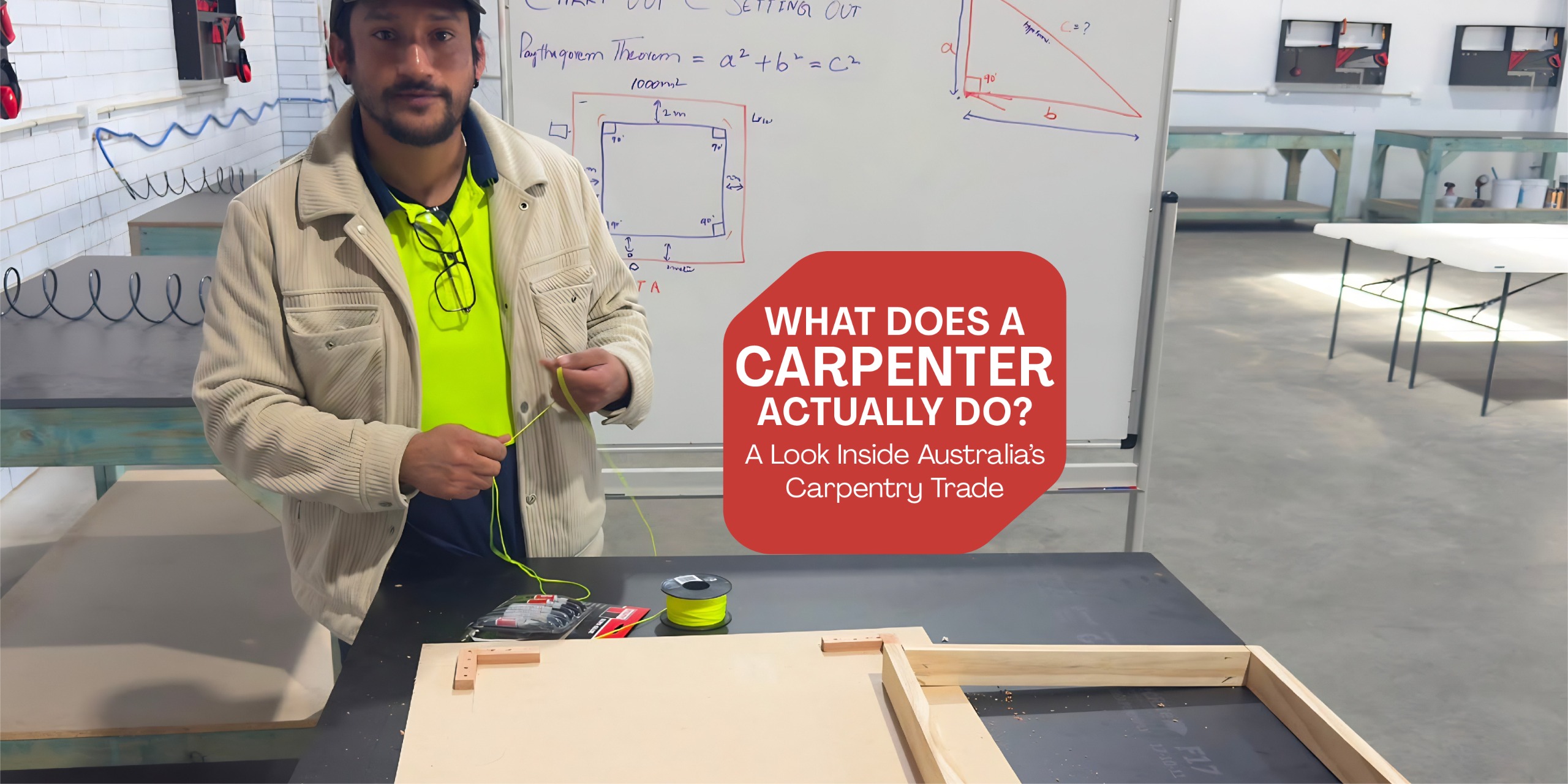
For anyone considering this pathway, it helps to know exactly what the training actually looks like day to day, not just what the trade involves once qualified.
At City College Perth, the CPC30220 Certificate III in Carpentry (CRICOS Course Code: 120454E) runs for 96 weeks, made up of 72 weeks of training and assessment across seven terms plus 24 weeks of scheduled holidays. The qualification is made up of 34 units in total, 27 core units and 7 elective units. [9]
The course is delivered through a combination of classroom instruction, scheduled and supervised online sessions, and practical training in a real workshop environment, with practical sessions held at the Construction Workshop, Unit 4/42 Gillam Drive, Kelmscott. [9]
Entry requirements include:
- An IELTS score of 6.0 or equivalent English competence [9]
- A minimum academic level of Year 11 or equivalent [9]
- Applicants must be 18 years or older at the time of enrolment [9]
- A course entry interview to confirm suitability [9]
Source [9]: City College Perth — CPC30220 Certificate III in Carpentry, Course Duration and Entry Requirements, citycollege.edu.au/course/CPC30220-certificate-iii-in-carpentry
City College also offers Recognition of Prior Learning and Credit Transfer for students who have already completed relevant units elsewhere. RPL and Credit Transfer are subject to assessment and course requirements, and any reduction in study duration or units depends on credit being granted. [10]
Source [10]: City College Perth — CPC30220 Certificate III in Carpentry, Recognition of Prior Learning / Credit Transfer, citycollege.edu.au/course/CPC30220-certificate-iii-in-carpentry
For students weighing up where to train, that combination, real workshop time from early in the course, a clear entry process. The direct pathway into further building and construction qualifications, is worth factoring in alongside the trade itself.
Frequently Asked Questions
Q1: What is the CPC30220 Certificate III in Carpentry?
Furthermore, it is the nationally recognised trade qualification for carpenters in Australia, covering setting out, framing, roofing, flooring, formwork, and finishing work across residential and commercial construction seo in perth. Additionally, the CRICOS course code at City College Perth is 120454E.
Q2: How long does the course take to complete?
The course runs for 96 weeks in total, made up of 72 weeks of training and assessment across seven terms, plus 24 weeks of scheduled holidays.
Q3: Do I need construction experience to enrol?
No prior construction experience is required. Instead, entry requirements are based on English language competence, minimum academic level, and age, along with a course entry interview to confirm suitability.
Q4: What can I do after I complete this qualification?
Subject to any applicable licensing or regulatory requirements, graduates may pursue work as carpenters or in related construction roles such as Residential Carpenter, Commercial Carpenter, or Industrial Carpenter. Many graduates also progress into the CPC40120 Certificate IV in Building and Construction to move toward site supervision.
Q5: Where does practical training take place?
Additionally, practical training for the CPC30220 at City College Perth takes place at the Construction Workshop, Unit 4/42 Gillam Drive, Kelmscott, alongside classroom and supervised online sessions.
Q6: Is carpentry only for men?
No. Women remain underrepresented in carpentry, but national data shows almost 80 per cent growth in women training in male-dominated trades, with specific growth recorded among women training as carpenters. Government-backed programs, including a $4 million investment in Western Australia, are actively supporting more women into this trade.
Q7: Can I progress to a higher qualification after this course?
Yes. Graduates of the CPC30220 can progress into the CPC40120 Certificate IV in Building and Construction. The further into higher level building and construction qualifications, moving from trade work into site supervision and management.
Q8: What is Recognition of Prior Learning (RPL)?
RPL allows students who already have relevant skills or experience to apply for credit toward units in the course. Which can reduce the time and cost of study. City College Perth accepts RPL and Credit Transfer applications prior to enrolment or at any time during study.
Note: Qualification completion and occupational or licensing requirements are separate matters; students should verify applicable Western Australia licensing requirements. To find out more about the Certificate III in Carpentry, visit citycollege.edu.au or reach the admissions team at admissions@citycollege.edu.au · marketing@citycollege.edu.au
RTO 91770 · CRICOS 04234E